The 60-30-10 Color Rule: A Designer's Guide to Perfect Room Colors Every Time
The 60-30-10 rule is the simplest formula for choosing room colors that always look balanced. Here's how designers actually use it — with real examples.
The 60-30-10 Color Rule: A Designer’s Guide to Perfect Room Colors Every Time
You’ve probably found yourself standing in a paint store, staring at forty shades of beige that all look identical under fluorescent lighting, wondering how anyone makes a confident color decision. Or maybe you’ve watched someone’s living room tour online and thought: that room looks expensive, but I can’t figure out why.
The answer, almost every time, is proportion.
A beautiful room isn’t about picking the “right” colors. It’s about putting them in the right ratio. And for that, there’s a rule that’s been quietly governing great design for decades. It’s called the 60-30-10 rule, and once you learn it, you’ll start seeing it everywhere — in rooms, in fashion, in film sets, in every space that just somehow “works.”
What Is the 60-30-10 Rule?
It’s a proportion system. Take any room and divide its visual weight into three categories:
- 60% — The dominant color. This is the backdrop, the foundation. Walls, large furniture pieces, and major flooring surfaces.
- 30% — The secondary color. This creates contrast and visual interest. Curtains, accent furniture, rugs, bedding, and upholstery.
- 10% — The accent color. The spark. Throw pillows, decorative objects, art, small accessories, and statement lighting.
That’s the entire rule. It’s not about specific colors — it’s about how much of each one you use. And the reason it works is almost mathematical: the human eye finds this proportion naturally balanced. Too much of one color is monotonous. Equal amounts of three colors is chaotic. 60-30-10 sits exactly in the sweet spot.
Why This Rule Works Every Time
Think about it in terms of music. A song with one instrument playing one note is boring. Three instruments all playing at the same volume is noise. But one instrument carrying the melody, another providing harmony, and a third adding occasional flourishes? That’s music.
Color in a room works identically.
The 60% is your melody — the tone that defines the room. The 30% is the harmony — it supports the dominant color and adds depth. The 10% is the solo — the moment of surprise, the detail your eye catches and holds.
When all three are in proportion, the room reads as cohesive and interesting. It has unity without boredom, variety without chaos.
Breaking It Down: What Goes Where
The 60% — Your Foundation
This is the color that covers the most surface area. In most rooms, this means:
- Walls (the single largest surface in any room)
- Ceiling (if painted a color — white ceilings default to neutral)
- Large furniture (a sofa, a bed frame, large built-in shelving)
- Major flooring (if it’s a distinct color rather than neutral wood)
Best choices for the 60%: Quiet, livable colors you won’t tire of. Warm whites, creams, soft greys, oatmeal, light sage, or pale clay. Nothing that fights for attention — this is the background that makes everything else sing.
A common mistake here is choosing an “exciting” dominant color. A room with 60% deep teal walls sounds bold in theory. In practice, it’s exhausting. Save the drama for the 30% and 10%.
The 30% — Your Supporting Act
This is where the room gets its personality. The secondary color should have enough contrast with the 60% to be clearly different, but enough relationship to feel connected.
Surfaces for the 30%:
- Curtains and drapes
- A large rug
- Upholstered accent furniture (dining chairs, an armchair)
- Bedding (duvet cover, bed throw)
- A painted piece of furniture (a bookcase, a sideboard)
The relationship to get right: Your 30% should be noticeably different from the 60%, but from the same visual temperature. Warm dominant (cream walls) pairs with warm secondary (terracotta curtains). Cool dominant (pale blue-grey walls) pairs with cool secondary (slate blue sofa cushions).
If you mix a warm dominant with a cool secondary — say, cream walls with an icy blue rug — the room feels like two different design decisions fighting each other. Not always wrong, but hard to pull off without experience.
The 10% — Your Punctuation
This is the smallest amount, and paradoxically, the part people notice first. Accent colors work precisely because there’s so little of them. They pop against the larger surfaces.
Where the 10% lives:
- Throw pillows (2-3, not a dozen)
- Decorative objects (a vase, a candle, a bowl)
- Art (a single statement piece or a set of prints)
- Lamp bases or shades
- A single accent chair (if small)
- Hardware and fixtures (drawer pulls, light switch plates)
Best choices for the 10%: This is your chance to be bold. Mustard yellow, deep emerald, burnt rust, inky navy, rich burgundy, or metallic gold. The accent color is a full-throated statement — the louder the color, the less of it you need.
The magic of the 10% is that it’s also the easiest to change. Tired of your room’s personality? Swap the pillows and the vase. Five minutes, completely different energy, 90% of the room still looks the same.
Real Palette Examples Using 60-30-10
🌿 Earthy Calm
| Role | Color | Where |
|---|---|---|
| 60% | Warm cream | Walls, large sofa |
| 30% | Sage green | Curtains, rug, dining chairs |
| 10% | Terracotta | Throw pillows, ceramic vase, art |
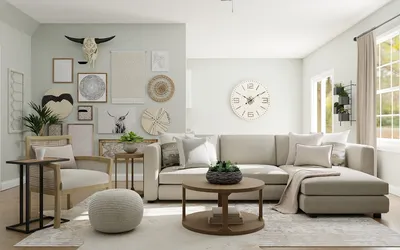
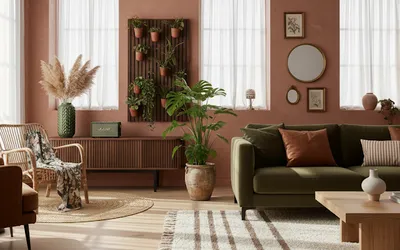
Why it works: Two warm-neutral colors create a grounded base, and the terracotta accent adds life without aggression. This is pure warm minimalism.
🏜️ Desert Modern
| Role | Color | Where |
|---|---|---|
| 60% | Sand / light beige | Walls, linen sofa, flooring |
| 30% | Warm clay / sienna | Rug, armchair, curtains |
| 10% | Deep olive green | Accent pillows, plants, a single shelf |
Why it works: The warm tones create a coherent visual story, and the olive green accent provides just enough cool contrast to feel alive. Works brilliantly in small living rooms because the palette is cohesive enough to avoid visual chaos.
🌙 Moody Sophistication
| Role | Color | Where |
|---|---|---|
| 60% | Charcoal grey | Walls (or feature wall + dark sofa) |
| 30% | Cream / off-white | Rug, curtains, bedding, art matting |
| 10% | Antique gold / brass | Lamp, mirror frame, hardware, candle holders |
Why it works: The dark foundation feels dramatic and enveloping, the cream lifts it from feeling cave-like, and the gold accents add quiet luxury. Best in bedrooms and home offices where you want focus and elegance.
🌊 Coastal Fresh
| Role | Color | Where |
|---|---|---|
| 60% | White / warm white | Walls, ceiling, main furniture |
| 30% | Soft blue-grey | Sofa upholstery, rug, linen curtains |
| 10% | Natural driftwood / rattan | Frames, baskets, side table, light fixture |
Why it works: Clean and airy without being sterile. The blue-grey carries the coastal feeling, and the natural wood accents keep it from feeling like a hospital.
Advanced Moves: Bending the Rule
Once you’re comfortable with 60-30-10, you can start playing.
The 60-30-10… Plus a Metallic
Metallics (brass, copper, matte black, gold) function almost separately from the color rule. Think of them as a fourth “flavor” that weaves through all three levels:
- Brass curtain rod (crosses the 30% zone)
- Gold lamp base (lives in the 10% zone)
- Matte black light switch (lives everywhere)
Metals add richness without adding color complexity. Use one metallic family throughout the room (all brass, all matte black — don’t mix metals unless you’re very confident). For guidance on mixing different material tones, see our guide on mixing wood tones — the same undertone logic applies to metals.
The Tonal 60-30-10
Instead of three different colors, use three different shades of one color. Pale mushroom walls (60%), medium taupe sofa (30%), dark espresso cushions (10%).
This creates a room that’s incredibly sophisticated and calming — essentially monochromatic, but with enough tonal variation to avoid flatness. It’s the approach behind most high-end hotel rooms and luxury spas.
The Inverted 60-30-10
In a room with very dark walls (charcoal, navy, forest green), the traditional light-dominant rule flips. Your 60% is dark, your 30% is light, and your 10% is either very bright or very metallic.
This works beautifully in rooms designed for atmosphere — a moody bedroom, a library nook, a media room. It doesn’t work well in rooms that need to feel airy and open.
Common Mistakes
Making the 10% too large. If your accent color covers more than about 10%, it stops being an accent and becomes a competing secondary color. Two prominent colors fighting for attention is the root of most “something feels off” rooms.
Choosing a dominant color you love too much. Your favorite color should probably be the 10%, not the 60%. You want to surround yourself with quiet, and let the color you love be the special moments. Deep emerald green is magical as a pillow and a vase. It’s oppressive as four walls.
Forgetting about texture within the 60%. If your dominant 60% is cream, your cream walls and cream sofa will look identical and flat unless you vary the texture — matte paint on the wall, linen on the cushions, bouclé on the throw. Same color, different material. That’s what gives the foundation depth.
Applying the rule too literally. You don’t need to measure percentages. The rule is a guideline, a way of thinking about proportion. If a room feels like one color dominates, another supports, and a third sparkles — you’ve nailed it, even if the exact ratio is 55-35-10 or 65-25-10.
Start Here
If you’re staring at your room right now and feeling overwhelmed, start with this:
- Name the dominant color already in your room (walls are usually it)
- Identify what’s playing the 30% role — is there a secondary color, or is everything the same?
- Look for the accent — is there a 10% that pops, or does the room lack a spark?
Usually, one of those three is missing or out of proportion. Adding a few terracotta cushions to a cream-and-grey room might be the only change you need. Swapping dark curtains for lighter ones might rebalance the whole space.
The rule isn’t about starting over. It’s about understanding why your room feels the way it does — and knowing exactly which color lever to pull.
Want to dive deeper into color? Check our posts on Pantone 2026 Cloud Dancer styling and Japandi bedroom color palettes for specific examples in action.
Need eyes on your space? Reach out to us with photos — we love a good color puzzle.